I’ve always been a teacher. I don’t think I can learn a new profession now, in my mid-forties and 20 years away from retirement. I feel internally paralyzed and embarrassed in front of my children because they see me unemployed for the first time.”
Maram learned German up to C1 level. Then the job center began to pressure her to arbitrarily find a job in any industry. But she was excluded from teaching at Berlin schools because of her headscarf. At first, she was deeply shocked. She didn’t know what a negative influence her head covering would have on the children. The explanation that children shouldn’t have contact with religious symbols, while paradoxically celebrating Christmas and Easter every year in school, didn’t convince her.
Over time, and under this pressure, she volunteered for an organization for refugee women, where her headscarf was no obstacle. She occasionally taught the children Arabic.
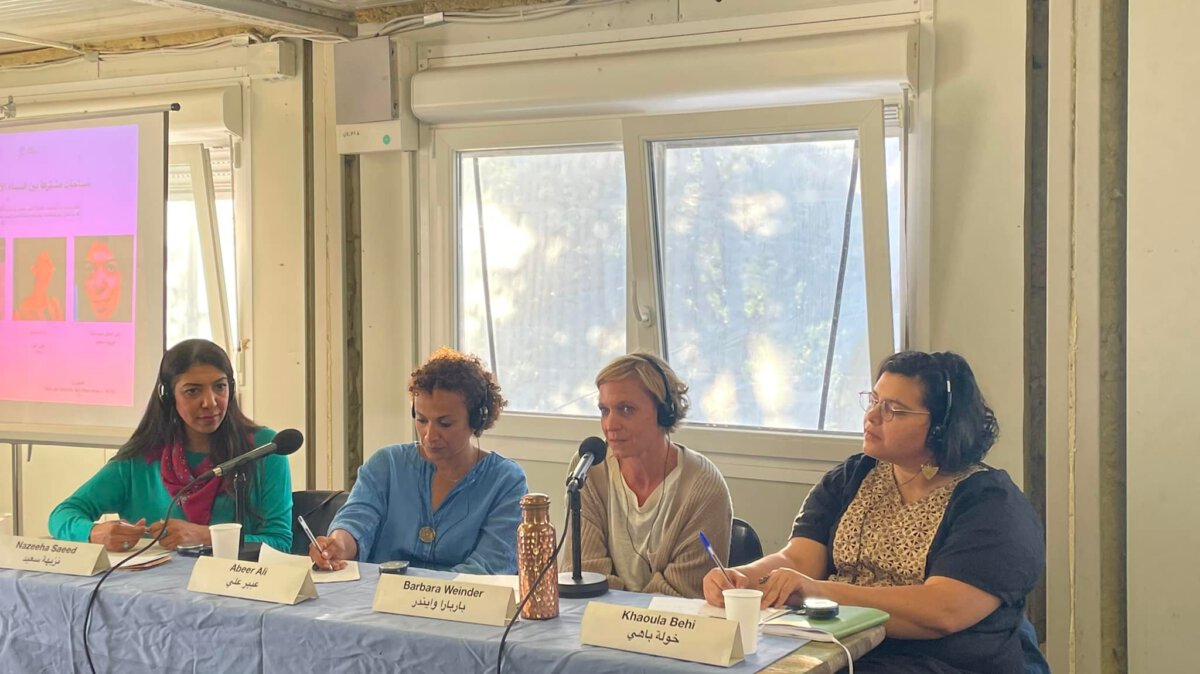
Abeer was also a teacher. She taught middle school mathematics for 15 years.
She knew from day one that her life was changing forever. She opened her heart to all the changes in her new life and She fought on all fronts to achieve success. But the hopelessness of her career path was clear to her. She had her degree recognized, gained experience while learning German at a high level, and then completed a degree in another subject, as this is a requirement to work as a school teacher in Germany. But one hurdle was insurmountable for her: herself. Her character, her appearance, everything she used to believe in throughout her life. She is now not entitled to exercise her freedom in choosing a career because her headscarf imposes invisible boundaries on her.
Abier tried to reformulate the last sentence to improve it: “It’s not my headscarf that limits me, but the neutrality law, which is by no means neutral.”
Former participants in the Young Refugee Leadership program run by the organization Women For Common Spaces conducted a survey with a small group of women wearing headscarves in Berlin. These women were between 24 and 40 years old, and most of them arrived in Germany after 2015. There is a consensus that there is a discrepancy between the opportunities of women with and without headscarves in the Berlin labor market.
85% of survey participants believe that the Neutrality Act undermines the right not to be discriminated against based on appearance or beliefs. 67% believe that this decision constitutes gender discrimination, as it affects only Muslim women, not Muslim men. According to 71% of participants, this law also structurally reinforces discrimination based on religious affiliation in the workplace, as it does not affect members of other religions except Muslim women.
This survey was conducted following the ruling of the European Court of Justice in Luxembourg on October 13, 2022, which allows employers to prohibit the visible wearing of religious, ideological, or spiritual symbols in the workplace. This applies if this internal rule applies equally to all employees and serves purposes such as conveying a neutral image to customers or avoiding social conflicts. The sole desire of the employer to convey a neutral image of the company is not sufficient for this.
The survey was conducted as part of a training program on a small group of women, so its results cannot be extrapolated to a meta-level. However, these results are consistent with the statements of the women wearing headscarves with whom we interviewed on the same topic. They reported on their experiences in the labor market in Berlin and on the prevailing discourse among migrant groups on social media – especially groups that support women’s and workers’ rights. These groups are trying to provide a platform for women affected by the ECJ’s decision and, equally, by the Berlin Neutrality Act. These two decisions reflect institutional discrimination pursued by the Berlin state government in violation of the constitution, which aims to ensure equal treatment of both sexes. This can be considered a significant case of gender discrimination.
The headscarf as a legal issue in German courts:
This is a chronological summary of the headscarf as a legal issue in Germany. In 2003, the Federal Constitutional Court (Bundesverfassungsgericht)